Showing posts with label Identity: Non-Binary. Show all posts

14 April 2024

Feel Good - "Allowing Enbies to Feel Bad and Feel Good"

In a more optimistic note, this post explores how stereotypes can be avoided while creating a compelling non-binary narrative.


Mae (Mae Martin, left) and George (Charlotte Ritchie, right) express many happy and sad queer stories through the 12 episodes of Feel Good [Image: Netflix] 


In my upcoming dissertation essay, I defined several negative tropes about non-binary representation in film and television. These include often being portrayed as an activist, an entitled youth, a pathetic crossdresser, a deceiving sexual harasser,  and as a tragic and cynical character. My analysis of that will be in a few months. However, I originally planned to end the essay with a positive example, but ran out of the word count so cut it. Thus, here it is: an analysis of why Feel Good is one of the best non-binary representations.


18 December 2023

Ricky Gervais: SuperNature - "The Irony is Lost"

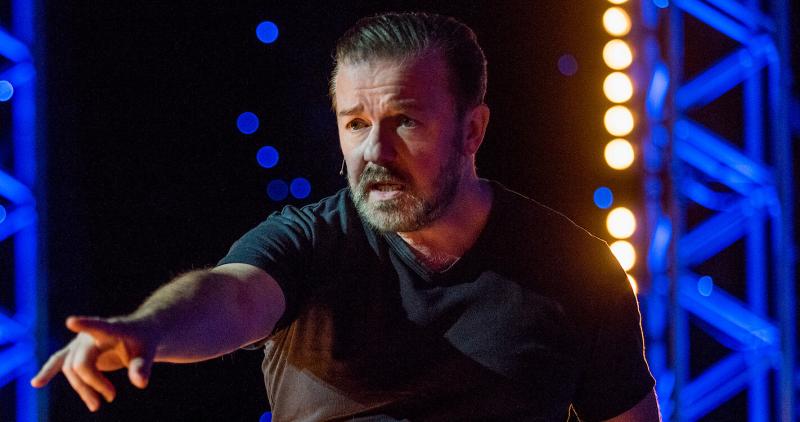
 It is only a week to go until Ricky Gervais's newest stand-up special releases on Netflix (for whatever reason Armageddon (Spencer, 2023) is coming on Christmas Day, which has a lot of implications into what the comedian thinks he is on level with). Ahead of this occasion, I thought it best to revisit last year's special, SuperNature (Spencer, 2022). Unlike other posts, this is an actual essay, which will be detailing whether Gervais' viewpoint that he can make jokes about anyone (including trans and non-binary individuals) is actually appropriate, or whether the "wokists" should cancel him forever.


Ricky Gervais is known for his annoyed and judgemental persona, but has he taken it too far [Copyright: Netflix]

-----------------------------------------------------------

There is an often-circulated rule of stand-up comedy which states “you can’t joke about it unless you are it”. This rule dictates that to make jokes about sensitive personal issues (being gay, trans, Black, female, Jewish, etc.) that you must yourself identify that way, otherwise it would be deemed inappropriate. However, many comedians take issue with this rule for various reasons. One such opposer of this is Ricky Gervais, a British, straight, cisgender, white, atheist man who regularly makes jokes regarding the holocaust, religion, and the LGBTQ+ community, specifically trans individuals. Gervais claims in his infamous stand-up special SuperNature (Spencer, 2022) that he “supports trans rights [as] trans rights are human rights” in real life. Although this is most likely true, his overall standpoint, persona, and use of comedy in SuperNature reinforces many stereotypes and perpetuates an anti-trans ideology in the audience’s mind. Therefore, this places into contention whether the "don’t joke about it unless you are it rule” should apply to Gervais’ comedy.

14 September 2023

John Wick: Chapter 3 - "Bureaucratic Fairness"

Looking into the use of accidental negative stereotypes and the positives of actors choosing their own identity


The Adjudicator (portrayed by Asia Kate Dillon, left) is an interesting character with a lot of mystery, including their gender identity [Copyright: Lionsgate]

-----------------------------------------------------------

After watching John Wick: Chapter 3 – Parabellum (Chad Stahelski, 2019), I asked my family if they noticed that there was a non-binary character in the film. They all said that they did not. This would be understandable if the character in question made a minor appearance in one scene. However, the non-binary character is actually one of the main antagonists of the film: The Adjudicator (portrayed by Asia Kate Dillon). Surely a scene confirming the gender identity would be wanted by audiences (probably only second to getting to see Keanu Reeves kill three people in a bar with a pencil). However, similarly to the world of John Wick, the representation is not as black and white as it first seems.

26 April 2023

Non-Binary = Non-Human - A Trope of Representation

Discussing a common negative trope in non-binary representation and how Netflix's Dead End: Paranormal Park combated it


Courtney (Bottom Left) in Dead End: Paranormal Park is not non-binary, but she is the best representation on this list
---------------------------------------------------------------------------

Futurama, Good Omens, The Good Place, Loki, Solar Opposites; these are just some examples of shows that feature non-human characters who are defined on the non-binary spectrum. However, this creates a few issues. Firstly, does this imply to be defined as non-binary is to not be human? And secondly, why does a character have to be non-human for writers to add representation?

28 March 2023

The Owl House - "Identity kept as a Whisper"

Discussing connoted viability in a series that is praised for LGBTQ+ representation


Raine Whispers from voice actor Avi Roque's Twitter (@ok_roque)

---------------------------------------------------------------


The Owl House is an animated series about a quirky but socially-isolated human girl (Luz Noceda, voiced by Sarah-Nicole Robles) who accidentally ends up in the Demon Realm, a fantasy land populated by witches and demons, and ruled by the mysterious Emperor Belos. The show follows Luz as she embraces her dream of living in a fantasy land and being looked after by the rebellious Eda “The Owl Lady” Clawthorne (Wendie Malick) and the confident and adorable King (Alex Hirsch) in the titular Owl House. The show, and its creator Dana Terrace, has been praised for its representation of LGBTQ+ and neurodivergent identities.


One such representation is the non-binary character Raine Whispers (voiced by Avi Roque, and Blu del Barrio (the latter voices the young version in flashbacks)). They are the first non-binary character portrayed in a Disney product. Raine features in a supporting role in nine episodes from their introduction in the episode “Eda’s Requiem” (S2:E7) to the most recent episode “For the Future” (S3:E2). In the show, they are the head witch of the bard coven, overlooked by the antagonist Emperor Belos, and are part of rebel groups against the emperor’s plans. They are also the ex of one of the main characters, Eda Clawthorne. Portrayed as an independent, cunning, and determined person, Raine is a complex and interesting character who is not defined by their identity. But is this lack of definition a positive or a negative for the wider representation?